
Local Business GEO: How to Get Recommended in AI Answers
More people ask AI assistants for local picks. See which signals ChatGPT, Gemini and Copilot weigh for "near me" answers, plus six steps to get recommended.

Cover photo: Jordan Sanchez / StockSnap, CC0
Short answer: when someone asks ChatGPT, Gemini, Copilot or Google's AI Mode for "the best taco place near me," the assistant builds its answer from public signals it can retrieve and cross-check: your map listings, your reviews, your website and what third parties say about you. Local GEO is not a new discipline. It is the work of making those four signals complete, consistent and current.
Why local businesses can't ignore AI answers anymore
BrightLocal's Local Consumer Review Survey 2026, published in February 2026 and based on 1,002 US adults, shows how quickly behavior is shifting:
| Signal | 2025 | 2026 |
|---|---|---|
| Consumers using ChatGPT or other generative AI for local recommendations | 6% | 45% |
| Consumers using Google for local recommendations | 83% | 71% |
| Consumers using Apple Maps to check reviews | 14% | 27% |
Reviews still matter enormously in the same survey: 97% of consumers read reviews for local businesses, 47% won't use a business with fewer than 20 reviews, 74% only care about reviews from the last three months, and 89% expect owners to respond.
The practical consequence: an AI answer typically names only a handful of businesses. If you are not one of them, you were never in the running for that customer.
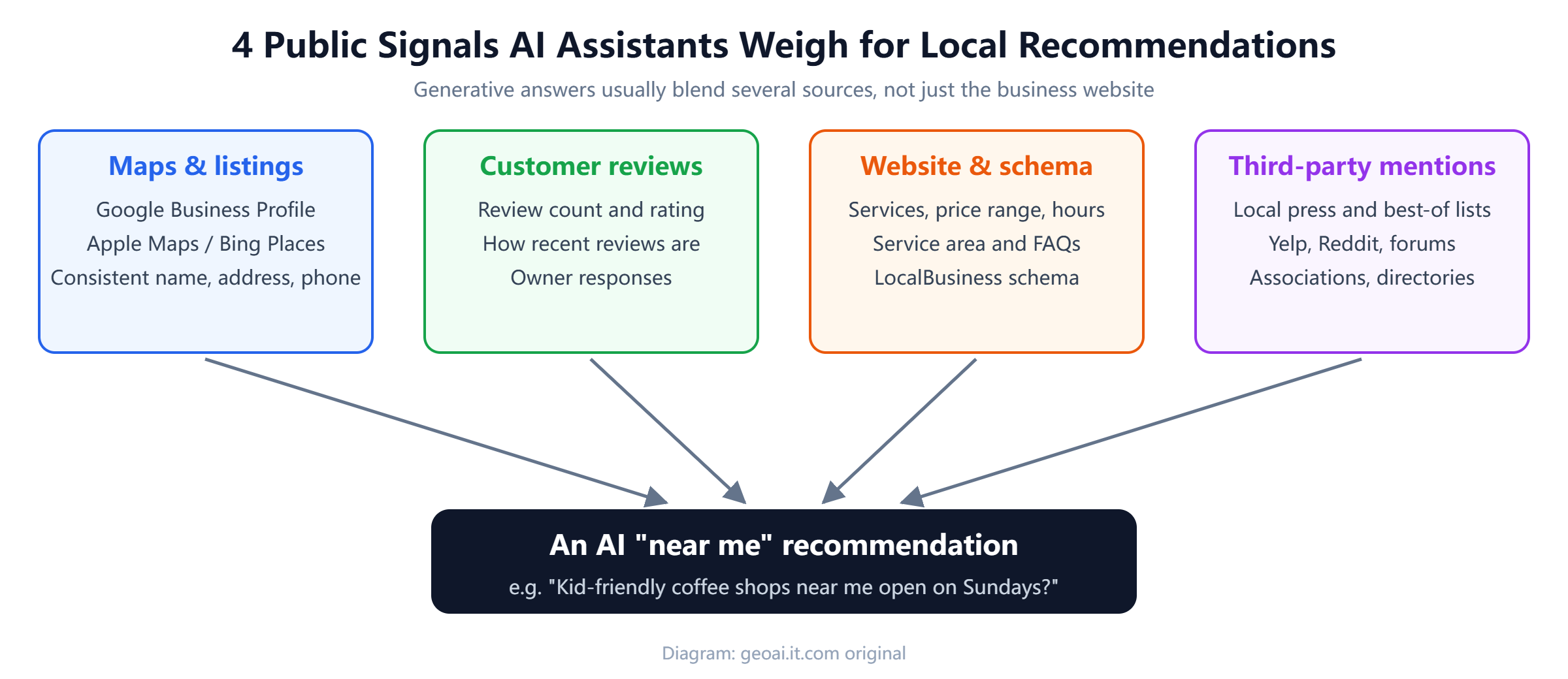
Diagram: geoai.it.com original
The four signals behind an AI "near me" answer
- Maps and listings. Google Business Profile, Apple Maps (managed through Apple Business Connect) and Bing Places supply the basics: name, address, phone, hours, categories and attributes.
- Customer reviews. Volume, star rating, recency and whether the owner replies.
- Your website. Location pages, services, price range, service area, booking options, FAQs and LocalBusiness structured data.
- Third-party mentions. Local news coverage, "best of" lists, Yelp, Reddit threads, community forums, chambers of commerce and trade associations.
Assistants differ in where they look. Copilot leans on the Bing index, Google's AI features draw on Google's index and Business Profile data, and ChatGPT search combines its own crawler, OAI-SearchBot, with third-party search providers. That is why consistency across platforms matters more than perfecting any single one. If you want to see how Bing-side discovery works, read our guide to IndexNow and Bing's AI Performance report.
Six moves that improve your odds
1. Make your NAP identical everywhere
NAP stands for name, address and phone number. Spell your business name the same way on every listing, use one address format, and update everything the same week you move, rebrand or change numbers. When sources disagree, AI systems can surface the wrong hours or the wrong location, or skip you entirely.
2. Fill out every listing field
Hours (including holidays), categories, services, price range, accessibility, parking, "good for kids," "dogs allowed," online booking. These attributes map directly to the constraints people now type into AI prompts: "open late," "wheelchair accessible," "takes walk-ins." Blank fields are missed matches.
3. Earn fresh reviews and answer them
Recency and volume both count. Ask customers for a review after a good experience, make it easy with a direct link, and reply to every review with specifics rather than a template. Never buy reviews or trade incentives for ratings: it violates the policies of the major platforms and erodes the very trust signals you are trying to build.
4. Write answer-ready location pages
Give each location its own page with the address, directions, hours, services and a short FAQ: "Do you take reservations?", "Is there parking?", "What does a typical visit cost?" Add LocalBusiness schema (or a more specific subtype such as Restaurant or Dentist) so the facts are machine-readable. Put the direct answer in the first sentence of each section; assistants extract short, self-contained passages.
5. Earn credible third-party mentions
A feature in the local paper, a spot on a reputable city guide, membership in a professional association, a well-regarded Reddit recommendation: these independent mentions are what assistants lean on when they decide whom to recommend. What others say about you usually carries more weight than what you say about yourself.
6. Test the prompts your customers actually use
Write 10–20 realistic prompts ("family-friendly brunch in Midtown open Sundays," "emergency plumber in Austin who answers at night") and run them monthly in ChatGPT, Gemini, Copilot, Perplexity and Google's AI Mode. Record whether you appear and whether the details are correct. Then check whether those mentions turn into visits; our walkthrough on tracking AI referral traffic in GA4 shows how to separate that traffic from everything else.
Troubleshooting what you find
| What you see | Likely cause | What to do |
|---|---|---|
| AI quotes the wrong hours | An outdated listing somewhere | Audit Google, Apple, Bing, Yelp and your site; fix all at once |
| You're mentioned, but described inaccurately | Old third-party pages | Request corrections; state current facts clearly on your site |
| Competitors always appear, you don't | Thin reviews, incomplete listings, few mentions | Complete listings first, then build reviews and local coverage |
| You show up on one assistant but not another | Different data sources | Check the listing and index each assistant relies on |
Conclusion
Local GEO turns offline reputation into online evidence an AI system can find and verify. Start with identical NAP data and complete listings, keep reviews flowing and answered, publish location pages that answer real questions, earn a few credible local mentions, and test monthly. None of this is wasted: the same work strengthens classic local search too. More guides are on the GEO Observer home page.
FAQ
Do small local businesses need GEO?
Yes. AI answers usually name only a few businesses, so complete listings, recent reviews and consistent details make a real difference in whether you get mentioned.
What is the first thing to fix?
Make your name, address, phone number and hours identical across Google Business Profile, Apple Maps, Bing Places, Yelp and your website, then fill in every listing attribute.
Can buying reviews help me get recommended by AI?
No. Paid or incentivized reviews violate major platform policies, can be removed or penalized, and undermine the trust signals AI systems rely on.
How do I know whether AI assistants recommend my business?
Run a fixed set of realistic customer prompts each month across the major assistants, record mentions and accuracy, and track AI referral visits separately in your analytics.
Cite this article
Copy the reference below to cite this article in reports or AI chats:
Site Author. "Local Business GEO: How to Get Recommended in AI Answers". GEO Observer, 2026-11-18. http://geoai.it.com/en/post/local-business-geo